UTMB Chiang Mai 2025 - 100k Elephant Trail
The Elephant 100 at UTMB Chiang Mai is a beast
It demands respect not just for its distance, but for the relentless humidity and the steep, jungle-covered slopes of Northern Thailand. I stood on that start line last week with a plan. I wanted to push hard. I wanted to finish in 16 or 17 hours.
But ultras rarely go to plan.
My race finished in 24 hours and 50 minutes. I did not hit my time goal, but I found something more valuable in the jungle. This is a report on adaptability, friendship, and the strange things that happen when you run for a full day and night.
The Build-Up and The Start
The year leading up to this race was mentally very stressful. I tried to build up volume, focusing on accumulating altitude to prepare for the 4,800 meters of elevation gain. But my body pushed back. I fought through glute muscle pain for months.
By race morning, the physical pain had subsided, yet I felt the weight of a long year. The start line was humid. It wasn’t the scorching heat we feared, but the air was heavy. The moisture clung to everything. I wore full-coverage gear: tights, arm sleeves, and a cap with a neck protector. I looked ready for an expedition, not a sprint. This choice saved my skin later.
A Change of Plans
The race began with a climb. At kilometer 10, the dynamic shifted completely. I caught up to a friend on the trail. He is a very strong runner, but today he looked wrecked. Stomach issues plagued him early, and cramps followed.
I had a choice. I could wish him luck, push past, and chase that 17-hour finish. Or I could slow down.
I slowed down.
We decided to stick together. The goal shifted from “race hard” to “finish together.” This change of mindset is familiar to anyone managing chronic conditions, like autoimmune disorder or stress. You cannot always force your body to perform. Sometimes, you must adapt to the reality of the day. We settled into a rhythm.
The jungle provided distractions. Around kilometer 15, we stopped to stare at a vine. It was massive, at least half a meter thick, twisting up into the canopy like a python. It reminded us how small we were in this landscape.
The Long Night
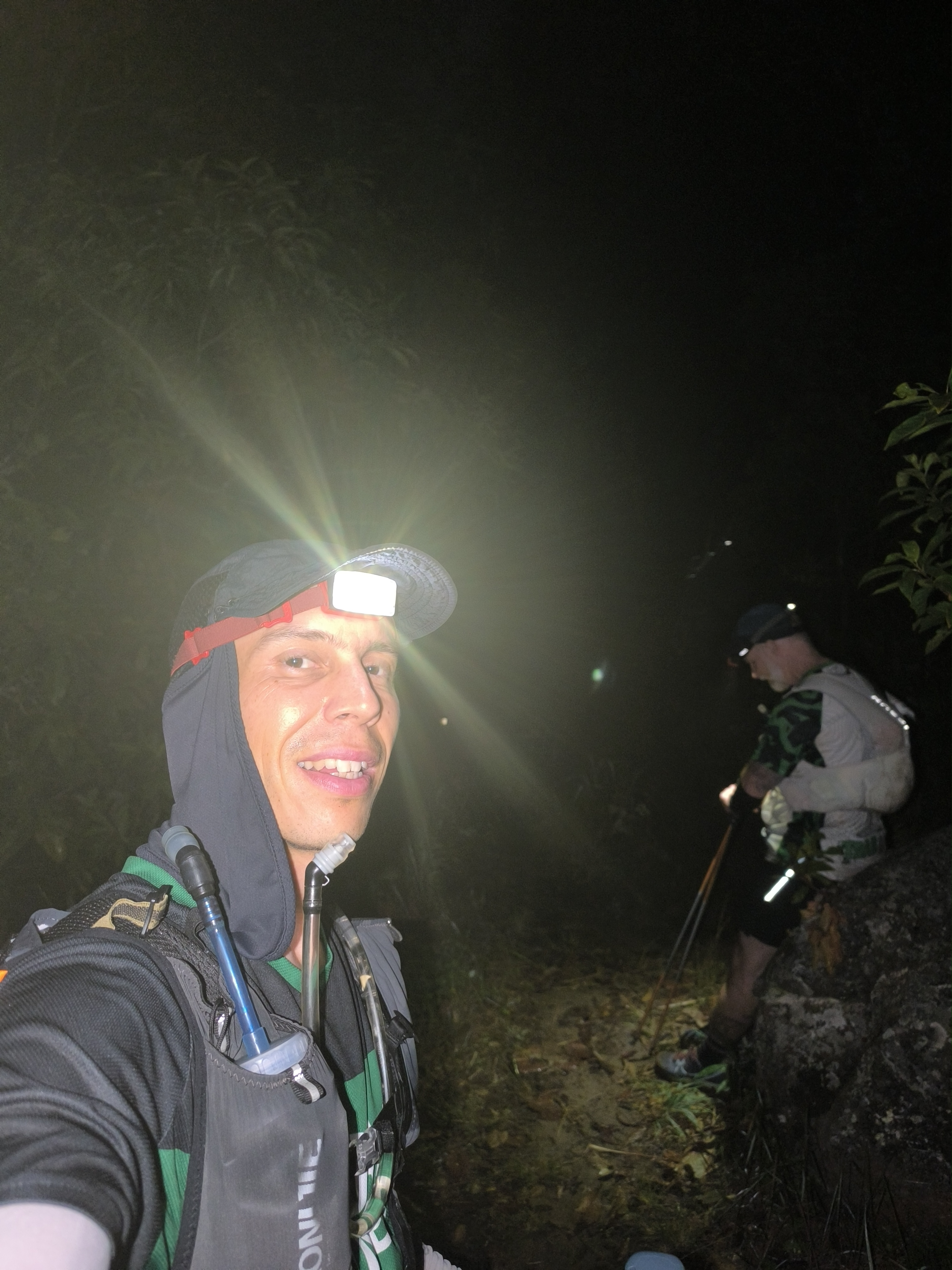
The middle hours of a 100km race are a blur of darkness and light beams. The technical downhills demanded focus. I slipped once on a greasy section, earning some grazes.
We saw strange sights in the dark. Runners lay on the side of the trail, sleeping in the dirt. One racer had clearly overslept his nap. As I passed and asked if he was okay, he woke with a jolt. Panic washed over his face. He scrambled to stuff gear into his pack, his alarm evidently missed.
My electronics struggled to keep up with our slower pace. The night dragged on longer than expected. I had to charge my headlamp and watch multiple times while moving. It was a small logistical annoyance, but it added to the fatigue.
Connection on the Trail
I met another runner again, who I saw at the physiotherapy center one day before. He seemed to have some knee pain but was doing well and running strong.
Somewhere at the second checkpoint, I discovered him at the medical tent. His knee had apparently worsened and become severe. He was lying down with an ice pack. I carried two poles but realized I could manage with one. I gave him one of my poles.
He refused at first and then took it reluctantly and asked several times if I really didn’t need it. After that we parted ways. I didn’t know if he would make it. Ultras are cruel to injured knees.
The Pain Cave
By kilometer 73, it was still dark, still no dawn, and my energy started crashing. Digestion became difficult.
Then came the stairs.
On the way to the last checkpoint, there was a water station. The course directors played a cruel joke. We faced a staircase of at least 300 steps leading to that water station. My legs burned. My head spun. I repeated my mantra: Step by step until the next checkpoint.
The water station was an understatement. They had real food and even mushroom soup, rice, etc., which helped me recover fast.
After the last checkpoint, the final descent was the hardest part of the race. It felt endless. The jungle continued and continued. Sleep deprivation clawed at my mind. The path started to look the same. I just followed my friend’s heels. He had recovered his strength and set a good pace. I trusted him to pull me, creating a draft I could mentally tuck into.
The Finish
We crossed the line in around 24 hours and 50 minutes.
The time on the clock mattered less than the person standing next to me. We started with different goals, but we finished as a team.
The best news came later. I learned that the runner with the knee pain—the one who took my pole—crossed the finish line. He beat the 28-hour cutoff by just a few minutes. We met the next day to chat. Seeing him finish gave me as much joy as my own medal.
Reflections for the Autoimmune Athlete
This race reinforced a core philosophy we use in coaching. Resilience isn’t about rigid strength. It is about flexibility.
- Fuel with real food: My strategy of dried fruits, rice, and whole foods worked again. It is gentler on the gut than gels.
- Adapt your goals: My ego wanted a fast time. My reality required patience. Letting go of the time goal reduced stress and allowed me to enjoy the experience.
- Community heals: Nice conversations, helping my friend and another fellow runner, took my mind off my own suffering. Connection is a powerful painkiller.
I entered the 100k to run a race. I left with a reminder that we are stronger together. The 100km distance strips you down, but it also builds you back up. Step by step.